#30 Coal – The Miners
 Anyone who has spent any time in the Hazleton area after
1830 would know one industry has stood above all others for the impact it has
had on the lives of all who’ve lived here, even unto today – the Coal Industry.
Anyone who has spent any time in the Hazleton area after
1830 would know one industry has stood above all others for the impact it has
had on the lives of all who’ve lived here, even unto today – the Coal Industry.
If you have ever been in a coal mine, then you know what
I’m about to describe. The temperature swiftly drops 20 – 40 degrees as you
move further from the entrance into the mine until it reaches a constant, cool
level. The operators of the Lackawanna Coal Mine Tour say the
temperature in that mine is 53°F year round. Each sound, every sound, echoes
all around you. Shadows move and jump with each movement of the source of light
and should that light be turned off, one is engulfed in a darkness that can
only be described as “perfect”. You cannot see your hand in front of your face
even if it is touching your nose. A drop of cold water may fall on your nose
from the roof above you only to remind you of just what is above you as you
stand in this tunnel deep inside, under, a mountain.
 |
A brochure from the 1970’s.
The Miner is Coney Lazis
as depicted by George Harvin.
|
All the stories you have heard in the past about mines
run through your mind – pockets of poisonous gas, rock falls, cave-ins,
explosions, floods!! Suddenly, all you
want to do is run out of this place! But you are a tourist, you paid to make
this short trip into the Earth. You can leave. Others before you not
only had to stay for a full shift of work – 10 hours or more of hammering,
drilling, blasting – but then had to return to do it all again the next day and
each day thereafter or they didn’t get paid. It was their job.
Coal was a known quantity long before it was found in northeastern Pennsylvania, it just wasn’t known to be
in northeastern Pennsylvania. It wasn’t until 1791, according to a story
published in the Harper’s Weekly in 1857, when it was found by a man named
Philip Ginter, that people became aware of its presence. The story goes that
Ginter came upon a lump of it while he was running through the woods on Summit
Hill along the Lehigh River.[1]
However, that was only just when coal was discovered
along the Lehigh River, and even THAT fact as a “first” is apparently a “first”
of uncertainty. It seems coal was well-known to be in the Lackawanna/Luzerne/Carbon
Counties area for a very long time, probably from the first presence of “white”
men in the area. The presence of coal in these parts was well known as early as
1766, 1760 in Bucks County. It was being strip-mined in the Wyoming Valley and
shipped south via river barge down the Susquehanna River throughout the
Revolutionary War.[2]
This coal was not the “usual”, soft Bituminous Coal found
in other places. This stuff, called Anthracite Coal, was harder – both in
texture and to burn. They should have asked Obadiah Gore, Jr. how to burn it.
He was a blacksmith who lived in the Wyoming Valley in 1768. He knew how to
burn the stuff. Indeed, the Anthracite Coal Industry of northeastern
Pennsylvania marks its beginning by the date when Obadiah, after leaving for a
short time, returned from Connecticut; making 2018 the industry’s 250th
anniversary.[3]
However, it wasn’t until 1817 that a workable burning system was perfected
allowing the industry to advance.[4]
Closer to Hazleton, coal was found in 1826, the year
after John Drum (Philip, George, Jacob, Philip) was born. According
to local legend, John Charles went out one day to dig out a groundhog in the
area of present-day Hazleton and found coal[5] The rest, as they say, is history!
I’m told by his Great, Great, Great Grandson, life-long Drums resident Bob Ray,[8] that not only did he find coal, he got the groundhog, too! Charles was a blacksmith in Conyngham so certainly knew what coal was and what to do with it. He was born April 2, 1778 in Moore, PA. He served in both the War of 1812 and the Mexican-American War. Because of his service, he was granted land in Sugarloaf where he set up his blacksmith shop. He died at the age of 95, January 16, 1874.
I’m told by his Great, Great, Great Grandson, life-long Drums resident Bob Ray,[8] that not only did he find coal, he got the groundhog, too! Charles was a blacksmith in Conyngham so certainly knew what coal was and what to do with it. He was born April 2, 1778 in Moore, PA. He served in both the War of 1812 and the Mexican-American War. Because of his service, he was granted land in Sugarloaf where he set up his blacksmith shop. He died at the age of 95, January 16, 1874.
Needless to say, the discovery of coal in this area started a coal mining industry which provided employment for a great many area residents. The first of Philip’s descendants of whom we are aware of
finding employment in the coal mines was John A. Drum(John, Philip, George,
Jacob, Philip). He was 20-years-old in 1880 when he was listed in that
year’s Census as a “Laborer in Coal Mine.” He must have found the work agreeable,
or at least sustainable, because his brother, Nathan A., is listed as being a miner
in the 1900 Census. John, however, is apparently no longer a miner by 1900. His
place of residence changed by then, as well. When these changes occurred is
uncertain, however, due to the lack of census data for 1890. He appears in the
1900 census as living in Schuylkill Haven, a town about 40 miles south of Drums
in Schuylkill County, earning his living as a “House Carpenter”. [6]
Two of his sons, however, are contributing to the household income via
employment with the mines; William (age 15) and Calvin (age 11); are both
listed as “Slate Pickers”.
 |
| Nathan A. Drum From the family portrait taken in the early 1900’s |
Nathan A. Drum, age 32 in 1900, probably was a miner even
by 1890 when he was 22, however, Census or other records are lacking that can
verify this as the case. Living with Nathan in 1900 was his wife’s brother,
John C. Balliett, and he, too, had found employment in the mines. John Balliett
was only 16 but both he and Nathan are listed as “Mine Laborers”.
 On May 30, 1893, Nathan took Mary Ann Balliett
to be his wife. By 1895, they had welcomed their first son into the world and
named him Elmer Alonzo. Two years later, Elmer’s sister, Christie Alice, was
born. Then in 1901, Nathan and Mary
became the parents of a third child and named him Walter.
On May 30, 1893, Nathan took Mary Ann Balliett
to be his wife. By 1895, they had welcomed their first son into the world and
named him Elmer Alonzo. Two years later, Elmer’s sister, Christie Alice, was
born. Then in 1901, Nathan and Mary
became the parents of a third child and named him Walter.  |
| This lamb was displayed in a Drum home for many years; in our house for as long as I can remember. Nathan and Mary had this marble lamb carved in memory of little Walter. |
Walter gave the family great joy for almost a year but
just a few weeks before his first birthday, Walter contracted pneumonia. He
died on June 7, 1902. Had he lived, he would have celebrated his first birthday
on June 14. Heartbroken after Walter died, Mary declared she would never have
another child. She was true to her word.
 |
| Christie Drum Yoch. Photo taken approximately 1930. |
Christie married a 24-year-old coal miner named Paul Yoch
on June 10, 1922. She was 25-years-old. They had two sons, Marvin and Gordon. Christie
died nineteen years later, in 1941, while her son, Gordon, was overseas; an
Army Sargent, fighting in the second world war. Shortly thereafter, Marvin left
to fight as well; a member of the U.S. Army Air Corps. Gordon passed away in
1993 and Marvin followed in 2015. Photos of Gordon and Marvin were included in a
previous post entitled “and
World War II, too, for some of us.”
Although mining was the livelihood of many families, many
people found issues with the industry. They pointed out the dangers and stressed
the apparent lack of health and safety measures employed by the mine owners.
They said mine owners took advantage of the miners by forcing them to buy the
supplies they needed for work and home from the company store and “renting”
them the shacks they lived in at rates far too high, deducting the rent from
the miners’ pay. In the song “Sixteen Tons” made
famous by Tennessee Ernie Ford in 1955, we hear the lyrics,
You load sixteen tons, what do you get?
Another day older and deeper in debt
Another day older and deeper in debt
Saint Peter don't you call me 'cause I can't go
I owe my soul to the company store.
I owe my soul to the company store.
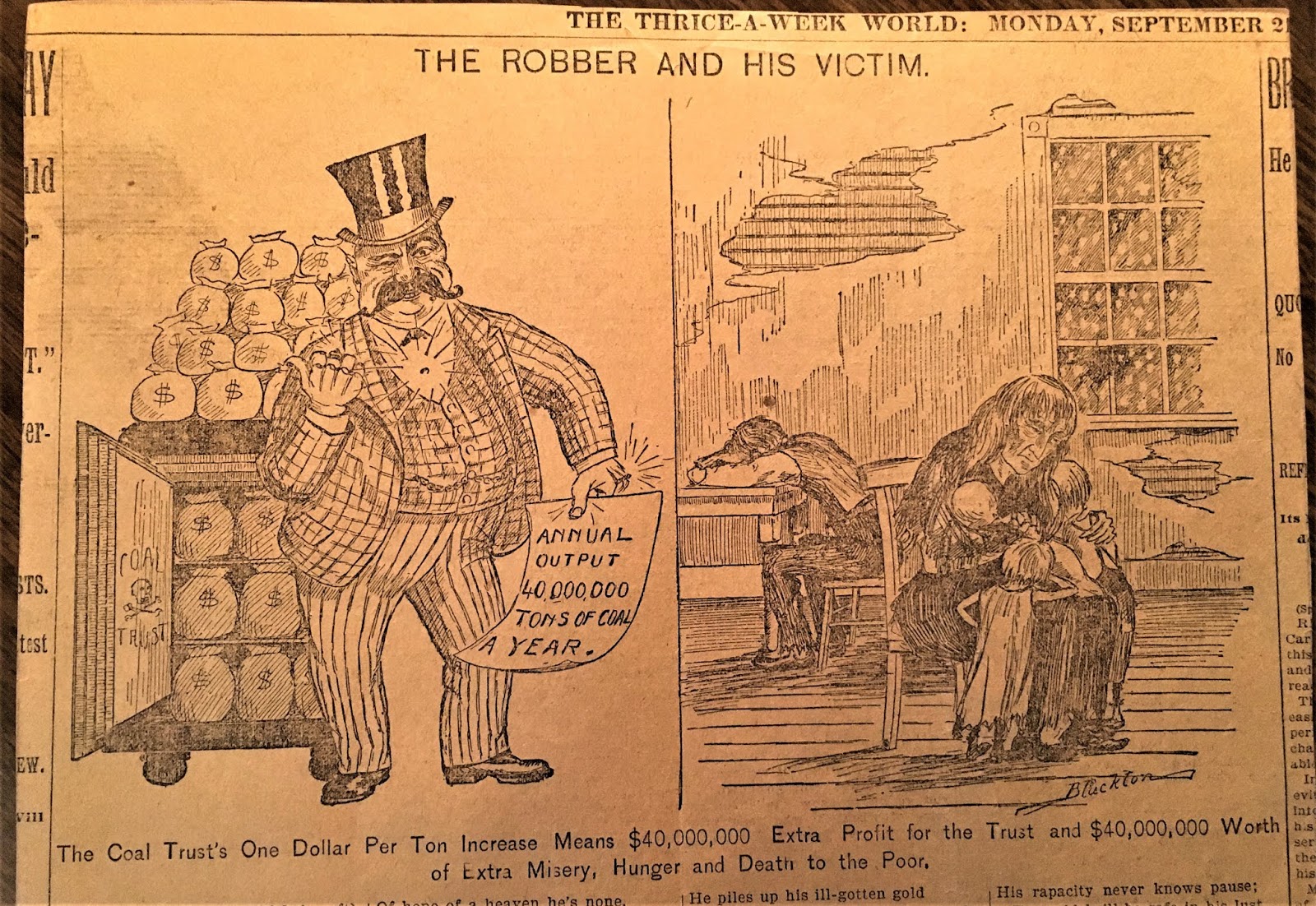
In the following cartoon, clipped from the September 21,
1896 issue of New York Thrice-A-Week World, we see a Coal Baron counting
his money as poor people suffer. This clipping was found among the many
clippings included in “The Hat Box Collection” (see the post Faith – In God for information
about, and a look into, this box of family papers reaching back to 1800). Ella Santee
Drum’s uncle, Jacob Santee, clipped many of the clippings from the 1920’s that
are included in this box. Was it “Uncle Jake”, as Ella called him, who clipped
this one as well or could it have been Nathan A. who did the honors?
So, it is not surprising that Unions began to form in the
Coal Fields of Pennsylvania. Nathan A. was a miner just when the United Mine
Workers (UMW) came into existence. How involved was he in this movement? Other
than his having paid union dues, we are left to wonder what he thought of the Union.
What was his opinion of John Mitchell and did he see Mitchell when he first
came to Hazleton in 1899? Was Nathan one of the 112,000 men who refused to work
during the strike of 1900? Surely, he was involved in the walkout of 1902 when
357 collieries went idle after 147,000 miners walked off the job.[7]
 He paid dues to the United Mine Workers of America for at
least 13.5 years, 1916 – 1930. Dues books he carried show payments to Local
Union #2168 of McAdoo 1916-1925 and Local Union #250 Lattimer Mines 1926 –
1930.
He paid dues to the United Mine Workers of America for at
least 13.5 years, 1916 – 1930. Dues books he carried show payments to Local
Union #2168 of McAdoo 1916-1925 and Local Union #250 Lattimer Mines 1926 –
1930.
Nathan’s primary income, like so many in this area, came
from the mines, but he also “made ends meet” financially through his carpentry and
blacksmith skills. His backyard garden and farm (chickens, cows, etc) helped to
provide food, as well.
Shown below is what appears to be a pay slip of Nathan’s. It
was found on the bottom of his carpenter tool chest. Eaten by silver fish,
mildewed, dirty, stained; it is still mostly legible. It is dated October 31.
The year was partially removed by a hungry silverfish but appears to be in the
1920’s which matches with his Lattimer Mines Due Books.

One wishes the fellow who wrote it had spent more time in
school studying penmanship but it seems to show a “Total Earnings” of $39.20
arrived at by adding an Allowance advance of $5.58 to wages earned entered
according to number of hours worked.
If I am reading these chicken scratches correctly, the
line for “Hours” says 124 @ .2711 = $33.62. At 8 hours a day, 124 hours is
approximately 15 days so, I hope this slip is for half a month and not all of
October.
Debits include $2.15 for the Lattimer Store and 50 cents
for what looks like “Coll”. It is things such as these that makes one wish an
ancestor was still around to ask! Perhaps this says “Call” and is a charge for
using the company telephone. Whatever it is, the total debits are $2.65 for a
balance of $36.55 due Nathan. In 2018 dollars that would be $538.61.
Census data indicates his role in the mines changed over
time: 1900 = Mine Laborer; 1910 = Coal Miner, Foreman; 1920 = Coal Mine,
Carpenter; and 1930 = Coal Mine, Laborer.
Mining, of course, was, and still is, a highly dangerous
occupation. I suppose it was more so in the beginning although I haven’t
checked statistics on that to know if true or not. However, the list of mine
disasters for the Anthracite Region is long, too long any way you slice it.
 The Avondale Fire, Twin Shaft in Pittston, Milnesville
Mine blast, Baltimore Tunnel in Wilkes-Barre, Pittston’s Knox Mine Disaster; to
name just a few; all too well known. One’s
heart fell when the Breaker Whistle blew. It meant death had come to visit one
of the mines yet again.
The Avondale Fire, Twin Shaft in Pittston, Milnesville
Mine blast, Baltimore Tunnel in Wilkes-Barre, Pittston’s Knox Mine Disaster; to
name just a few; all too well known. One’s
heart fell when the Breaker Whistle blew. It meant death had come to visit one
of the mines yet again. |
| A miner’s first aid kit probably carried by Nathan. For a story about this kit and a danger it presented for today, read the post entitled “No Boom is good BOOM!” |
Thankfully, to my knowledge, at least, Nathan was spared living
through an occurrence such as the Tomhicken Disaster. His was not a sudden
death, his was a more drawn out process. Perhaps he would rather have had the
sudden end vs. the one he got but we don’t get to make that choice. In any
case, we’ll never know.
The fact remains that Nathan spent much of his life working
in the mines, so it is reasonable to assume his death was most likely the
result of his occupation. His death certificate lists his cause of death as
“chronic pulmonary tuberculosis (fibroid type)”. Today this condition is one of
the conditions that is collectively called “Black Lung”. Nathan died on July
27, 1934. He was 66 years old.
 |
| Nathan A. Drum. A detail from a group picture taken in 1923. He was only 55 at this time but, to me, looks much older! |
He was not a miner when he died, according to the
information provided by his son, Elmer, for the death certificate. Elmer listed
his father’s occupation as “carpenter.” Nathan A. Drum is buried in the St
Johns Cemetery beside Mary Ann and Walter.
John C. Balliett may have started in the mines, but he
did not continue with the mines long. By 1910 we find him still living with his
sister and Nathan, but now he is listed as a “laborer, odd jobs.” Elmer also
appears to have found employment for a short time in the mines. He is listed in
the 1920 census as a “Blacksmith Helper in Mines”.
To my knowledge, there was only one more “connection” to
the mines of Pennsylvania from the extended part of “the tree”. My mom’s
father, Elton Shearer, worked in the mines as an electrician. He appears to
have begun this work at age 18 in the Pittsburgh area before he met my
Grandmother, Bertha Zboray. In fact, he would drive his motorcycle from
Pittsburgh to Milnesville every weekend to see her. He moved back here when
they got married in 1921. She was 18. He was 23. He went to work then in the anthracite
mines. Elton died in 1949 a week shy of his 51st birthday; of a heart attack.
 |
| Elton took both photos on the left making the one on top a “selfie!” On the lower left is a dog named Mr. Danby. Mr. Danby was a special friend because he not only wagged his tail, he sniffed out dangerous gasses. The photo on the right of Elton is an enlargement of the top left photo. Mom said he took these photos when he was 19 making the year 1917. |
That coal, and all the industries that surrounded the
mining of it, kept many a family alive cannot be denied. That it changed
everything it touched cannot be denied either. Fortunes were made because of it
and many a life was lost along the way. Even the environment was changed
because man dug in the ground for the stone that burns.
Return to Drums of Drums, PA on August 12, 2019 when
we’ll take a walk in the woods to get a closer look at coal mining’s
environmental impact on the Drums area as seen through The Mouth of Evil.
[1] “Buried
Treasure: Hunter Philip Ginter credited with finding anthracite coal at Summit
Hill in 1791”, Pages From the Past Special Edition, Hazleton
Standard-Speaker, Friday, Sept. 6, 1991, p B 2.
[2] Bradsby,
H.C., ed, History of Luzerne County, Pennsylvania (Chicago: S.B. Nelson
& Co., 1893). Chapter XI Coal. http://www.usgwarchives.net/pa/luzerne/1893hist/
accessed 8/6/2018.
[3]
Allabaugh, Denise, “Mining Milestone: 250 years after its discovery, anthracite
still heating homes” Hazleton Standard-Speaker, February 11, 2018, p C 1
[4]
Buried Treasure
[5]
Jackson, Kent, “Mining a rich vein: Old-timers remember life and death in deep
mines”, Pages From the Past Special Edition, Hazleton Standard-Speaker,
Friday, Sept. 6, 1991, p B 6.
[6] One
wonders if “House Carpenter” was a title used in that area for a Mine
Carpenter. It just seems odd that a person’s two young boys would be employed
in the mining industry but the father, who once was so employed, is no longer.
[7]
“Workers’ rights: UMW roots date to 1880s”, Pages From the Past Special
Edition, Hazleton Standard-Speaker, Friday, Sept. 6, 1991, p B 12.
[8] Conversation with Bob Ray, July 15, 2019, at Butler Active Adult Center in Drums.
[8] Conversation with Bob Ray, July 15, 2019, at Butler Active Adult Center in Drums.


